AI for documents: the AI found penalties in a contract that differ by a factor of 50
The test was run in Russian: the requests and the AI's answers are translated here, and the screenshots show the Russian interface.
We tested AI for documents on a supply contract. We took Yenisei, an AI that reads Word, Excel, and PDF files right on your computer, and asked it to put the contract's terms into a table and find the ones that are unfavorable to the buyer. The AI read the Word file, built an Excel spreadsheet, and showed that the buyer pays 50 times more for a delay than the supplier does.
- What it costs: there is a free plan.
- Where to get it: the app is at yenisei.ru/en/download, and the browser version is at chat.yenisei.ru.
- What it runs on: Windows, macOS, Linux.
- VPN: not needed.
What we gave the AI
A coffee supply contract worth 1,860,000 rubles. Its terms are typical for contracts like this: full prepayment, different penalties for each party, and the supplier's right to change the price.
Here is the request:
Our company is the buyer under this contract. Put the deadlines, amounts, and penalties for each party into an Excel spreadsheet and save it next to the contract. Then briefly list the clauses that are unfavorable to the buyer.
Before starting work, the AI suggested bringing in the specialist role of a contract lawyer, and we agreed. The app has 283 such specialist roles in all, among them an accountant, an HR officer, and a marketer.
What the AI found in the contract
The answer opened with the conclusion: the contract can be signed only with changes. Below it came a list of the unfavorable clauses, with the most dangerous ones first.
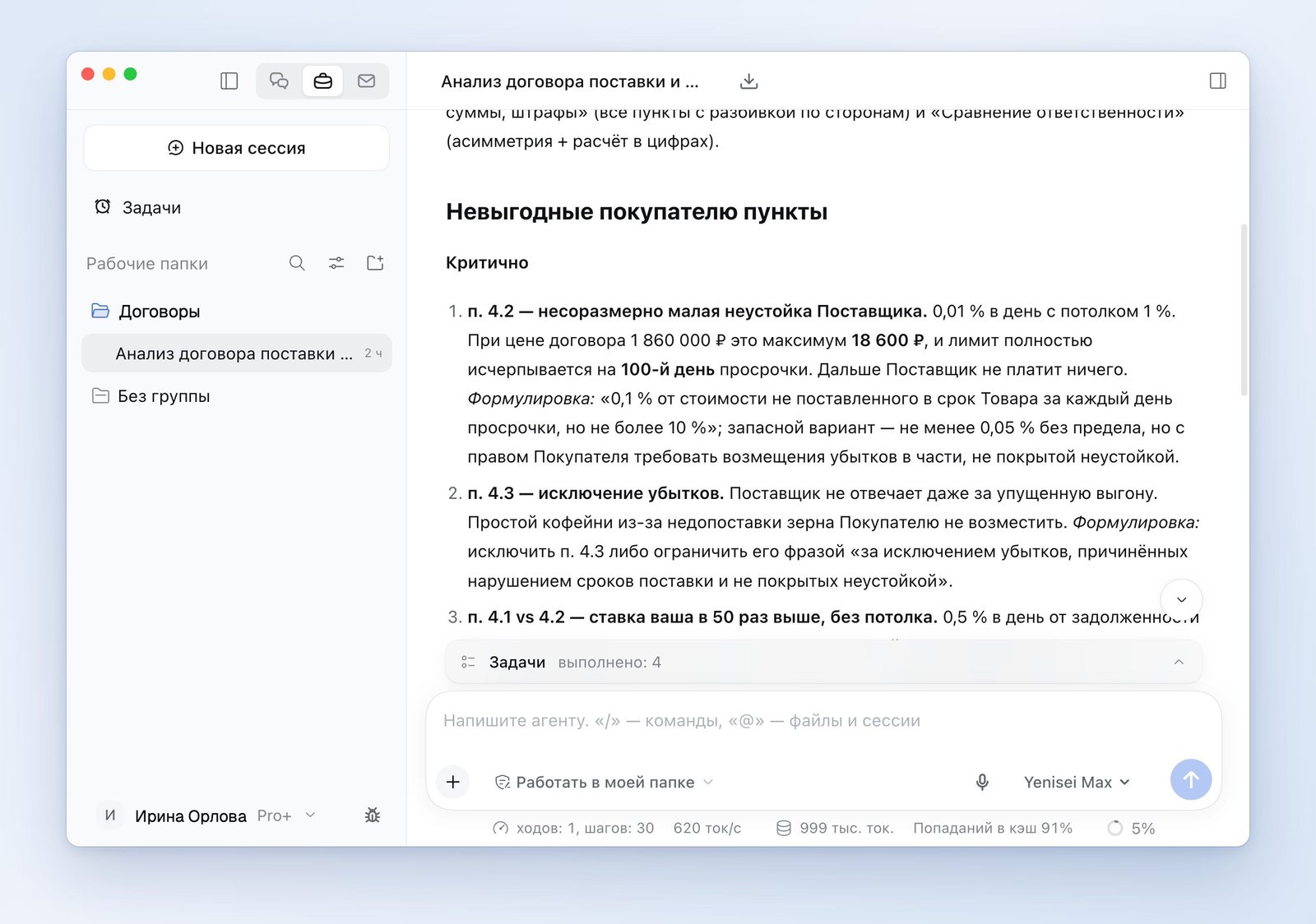
The AI collected the most important points on a separate sheet of the spreadsheet, under the heading "Asymmetry of liability: Buyer vs. Supplier."
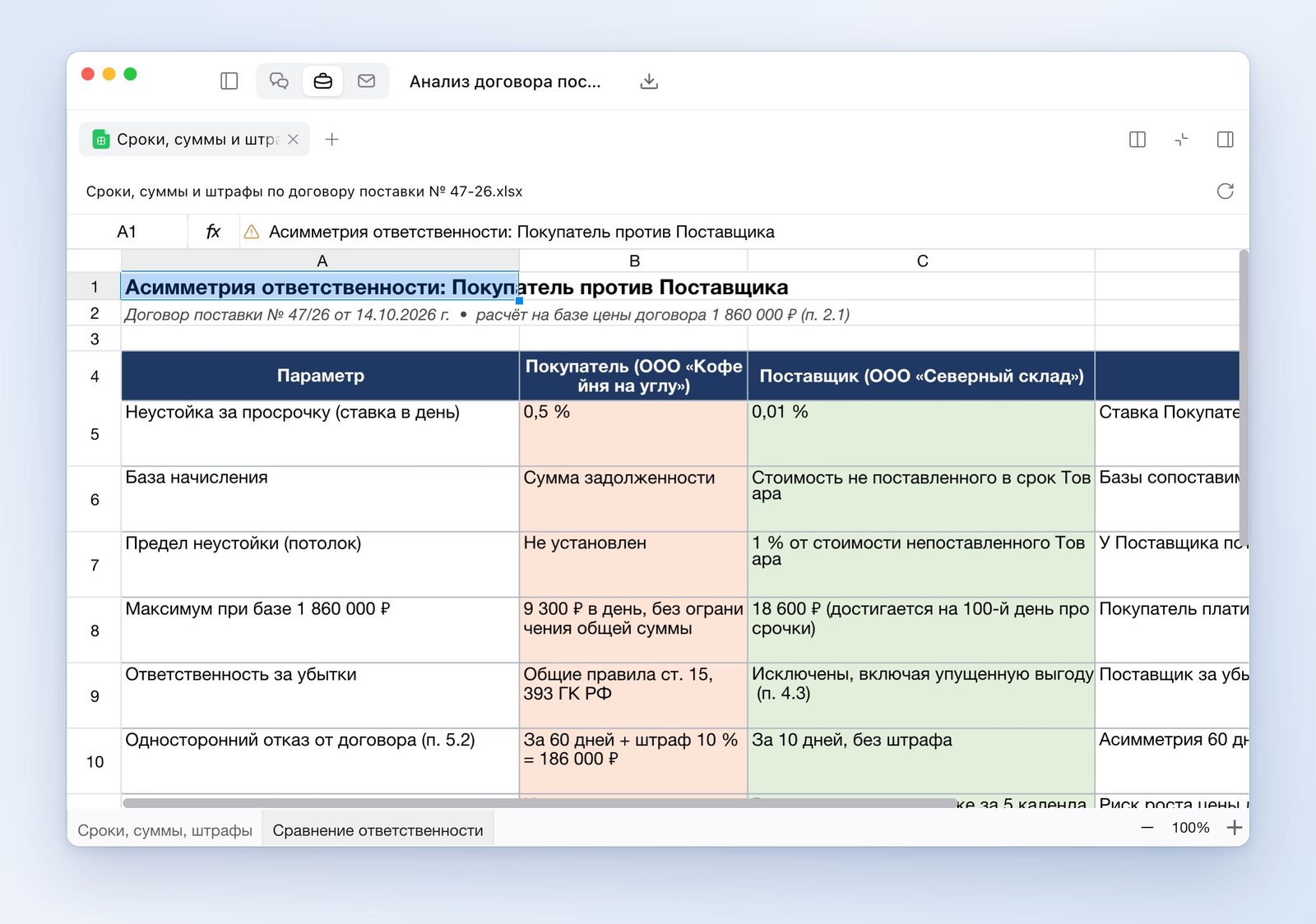
For late payment the buyer pays 0.5% per day, while the supplier pays 0.01% for late delivery. That is a 50-fold difference. In the contract these rates sit in neighboring clauses, but when you read straight through, the difference doesn't jump out.
Next, the AI converted the percentages into rubles:
- the buyer's delay costs 9,300 rubles a day, with no cap;
- the supplier's delay costs 186 rubles a day, but no more than 18,600 rubles;
- for a hundred days of delay the buyer will pay 930,000 rubles, and the supplier still the same 18,600;
- withdrawing from the contract costs the buyer 186,000 rubles, while the supplier can exit for free.
None of these amounts is in the contract. It has only percentages: "10% of the total amount" and "0.5% for each day."
How the AI worked with the document
The whole job took nine minutes. In that time the AI read the Word file, built a two-sheet Excel spreadsheet, and checked its own work.
The check was not a formality. At first the formulas in the spreadsheet pointed to the wrong cell: the AI noticed this and rebuilt the file. Then it found a typo and a cut-off line in its own work and fixed those too. We had not asked for this check.
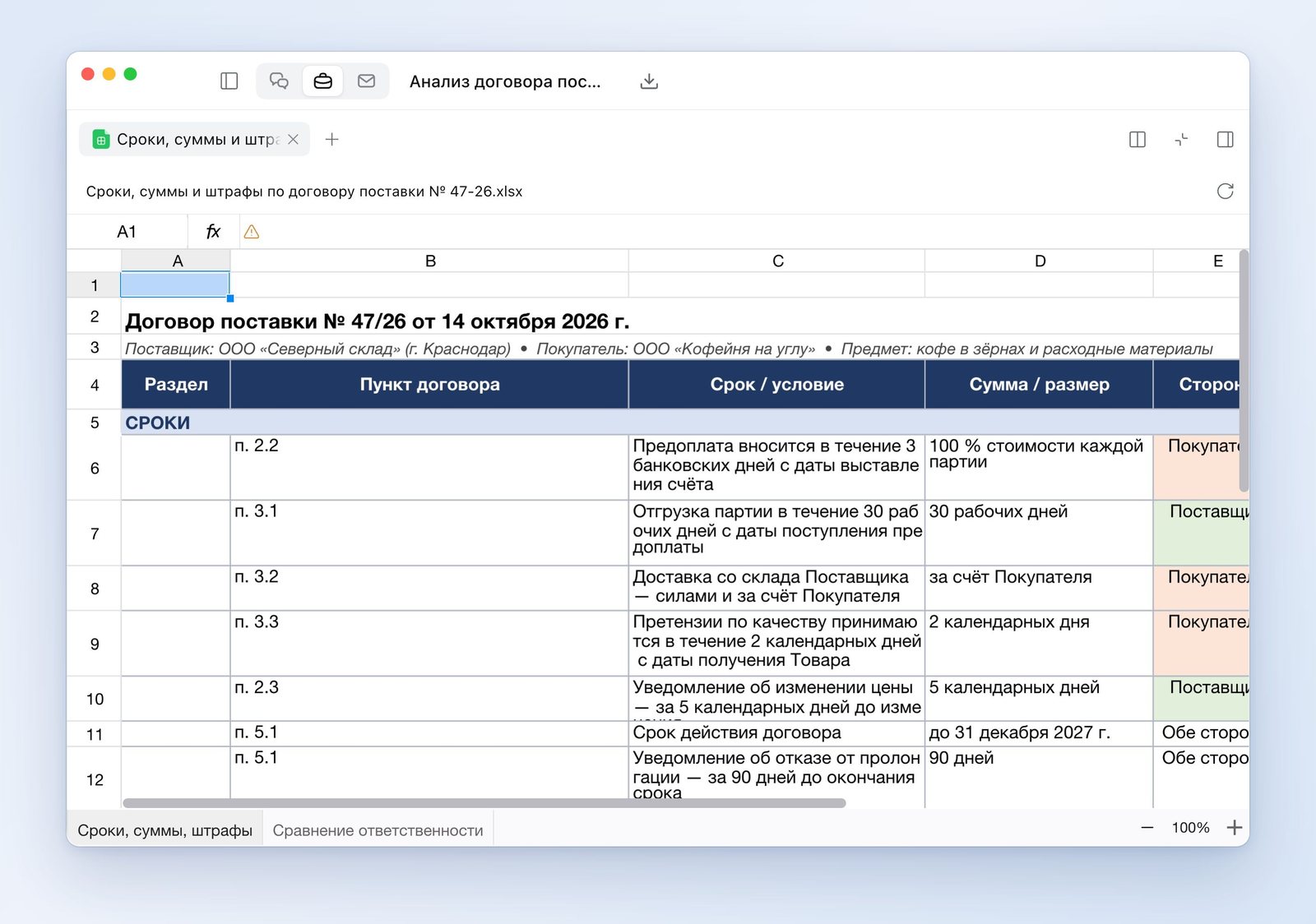
The spreadsheet opens right in the app. The first sheet has all the deadlines, amounts, and penalties, with clause numbers and notes for the buyer.
Where the AI got it wrong
It added one row of its own. The contract does not say a word about a pre-trial claim procedure, yet the spreadsheet shows "30 calendar days (general rule)." That is a rule of law, not a term of the contract. The note in parentheses is there, but it is easy to miss on a quick read.
At the end the AI itself wrote that the amounts and the case law should be checked with a lawyer. We agree: AI for document analysis cuts the time spent reading, but it is a person who signs.
Three more limitations:
- The AI cannot read a scan without a text layer on its own. It will ask for permission to send it for text recognition, and that is a paid service.
- Document size: up to 25 MB.
- Edits the AI has made to a file cannot be undone. For important documents there is «План» ("Plan") mode: the AI first shows what it is going to do and waits for your approval.
Which documents the AI reads
The AI reads Word, Excel, PowerPoint, PDF, OpenDocument, and RTF. Files are read on your computer, and no credits are spent on that. The AI can also create a document: a finished Word, Excel, PowerPoint, or PDF file appears in the folder.
What else you can hand off to AI for working with documents:
- combine three cost estimates from Excel into one table and calculate the total;
- find the old office address in every file in a folder;
- put together a Word report from notes and save a copy as a PDF;
- turn a long PDF into a summary with page references.
Where your documents go
The files stay on your computer. The AI parses them locally and sends off for processing only the text needed for the answer. Your conversations are stored on your computer too. Yenisei keeps only a usage record: which model did the work and how much text it processed.
File access is configurable. You can allow read-only access, and then no file will be changed.
What to choose
- One document, a one-off question — Yenisei Chat in the browser. You attach the file to a message and download the finished spreadsheet or document from the answer.
- A folder of documents, cost estimates, reports — Yenisei Agent. It sees the whole folder and saves the result to that same folder.
- A contract before signing — the app and a lawyer. The AI will show you what to pay attention to.
Try it on your own task
The agent works in the app for Windows, macOS and Linux. Sign in with your email and a code from the message; the basic plan is free.